
TESTING & INVESTIGATIONS
We carry out advanced on-site and laboratory investigations to evaluate the condition, strength, and durability of existing structures, supporting accurate engineering decisions and safe intervention planning.
CONCRETE
Core sampling is a technique used to obtain concrete specimens from existing structural elements for laboratory testing of the material's mechanical and physical properties. Cylindrical samples are extracted using specialized drilling equipment and analyzed in a laboratory to provide reliable information regarding the strength, quality, and condition of the concrete. This enables a more accurate assessment of the structure's load-bearing capacity and supports the planning of repair or strengthening interventions.

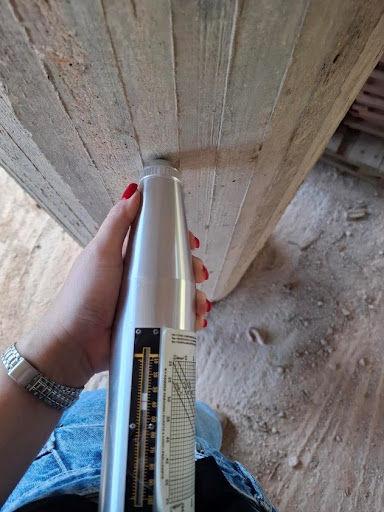
The rebound hammer test is used to estimate the strength and integrity of concrete. This method provides reliable information regarding the hardness and density of the material without requiring drilling or other invasive procedures. It allows for early identification of potential issues, evaluation of material quality, and supports maintenance and repair planning.
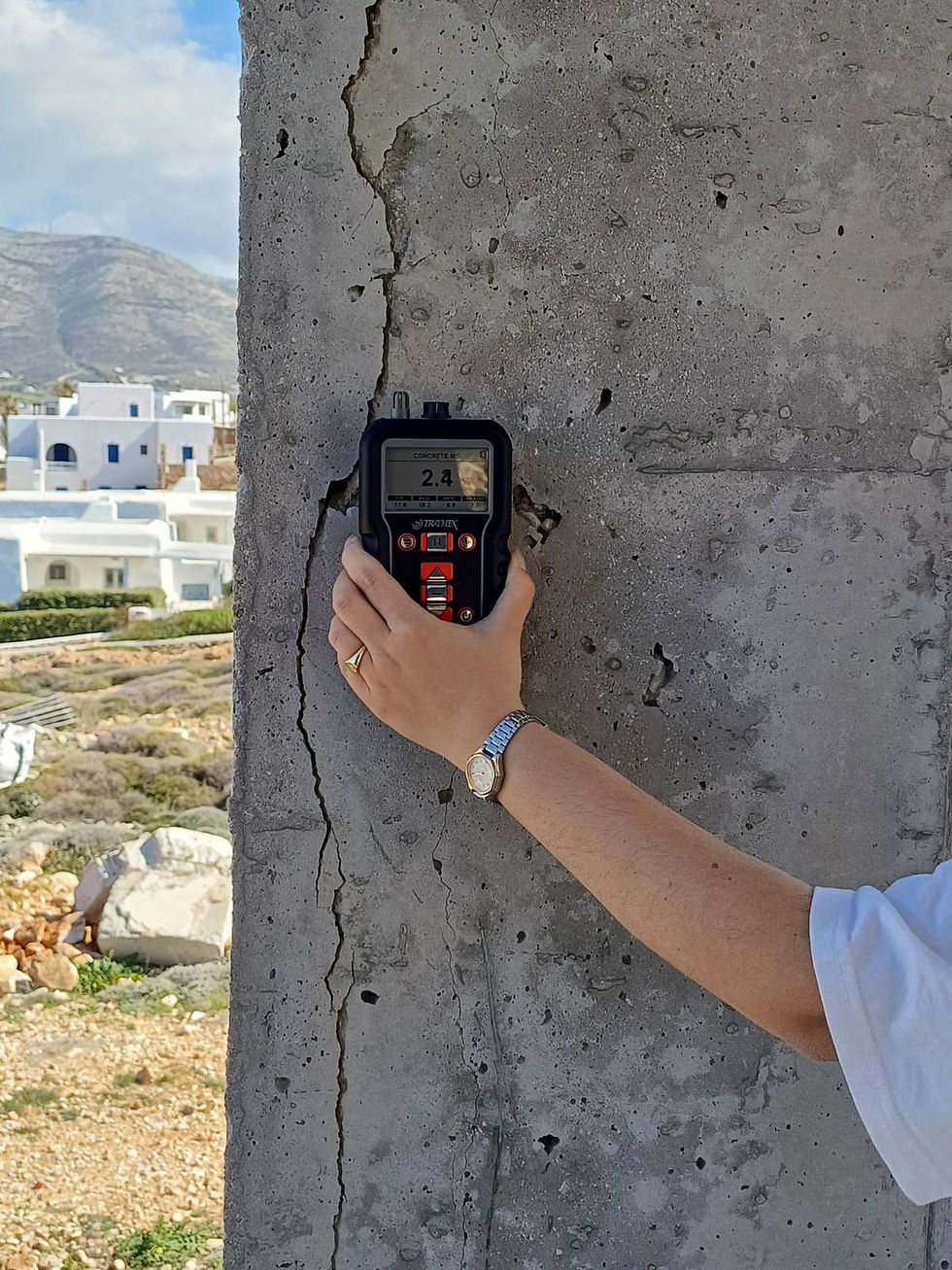
Measuring moisture content in concrete is essential for assessing the condition of a structure and the risk of reinforcement corrosion. High moisture levels can contribute to corrosion of reinforcing steel, causing long-term deterioration. Moisture may also affect the durability of the material, the performance of the concrete, and the effectiveness of repair works.
Chloride content analysis is an important procedure for evaluating the risk of reinforcement corrosion. Chloride ions can penetrate concrete through water or the atmosphere, especially in coastal areas or environments with high humidity. When chloride concentrations reach critical levels, they can compromise the protective alkalinity of the concrete and initiate corrosion of the reinforcement. Laboratory testing determines chloride concentrations and helps assess the need for protective or remedial measures. This method is essential for monitoring long-term durability and maintaining structural safety.

Concrete pH measurement is performed to evaluate the material's alkalinity, which is critical for protecting reinforcing steel against corrosion. A high pH level helps maintain a passive protective layer around the reinforcement, ensuring the long-term durability and stability of the structure.
.png)
Ultrasonic testing is used to evaluate the strength and integrity of concrete. The method measures the propagation speed of ultrasonic waves through the material, providing information about density, uniformity, and the presence of cracks or voids. It delivers accurate results without requiring invasive procedures, making it highly suitable for structural assessment, maintenance, and repair planning.
.png)


.png)
.png)
REINFORCEMENT
Reinforcement detection is a technique used to determine the location, dimensions, and layout of reinforcing steel within concrete. The method provides accurate information without requiring drilling or other invasive procedures, enabling precise documentation and supporting maintenance, repair, and strengthening works.
.png)
The Half-Cell Potential method is used to assess the likelihood of reinforcement corrosion by measuring the electrical potential difference between the reinforcing steel and a reference electrode. This technique provides a reliable evaluation of reinforcement condition and corrosion activity, helping engineers assess durability and structural integrity.
.png)
TOPOGRAPHIC
Settlement monitoring is a precise technique used to track vertical movement and evaluate the stability of structures or soil. It allows for continuous or periodic measurement of displacements without invasive procedures. The collected data supports structural safety assessments, corrective actions, and long-term maintenance planning.
.png)